Project Rumeli
Distributors across several countries were ordering through scattered channels, with pricing, approvals and claims all handled outside any single system. Marsos delivered one portal where distributors order in their own currency, orders flow straight into SAP, and approvals, claims and delivery status are visible in the same place as the order.
Delivery signals
Connected distributor commerce
One portal
replaces scattered distributor ordering channels
SAP-connected
orders and customer data reach the system of record directly
Local currency
each distributor buys and is invoiced in their own
One trail
approvals, claims and delivery status against every order
01 / Context
The operating environment
An international B2B ordering programme for a large FMCG manufacturer needed one controlled digital operating model for distributor purchasing and post-checkout servicing. The public case study keeps the client, distributor, warehouse, region, and endpoint identifiers anonymized.
02 / Business outcome
What changed for the client
The result this engagement delivered — before any of the engineering behind it.
Unified ordering, approvals, claims, and post-checkout visibility in one auditable B2B portal.
Created a reusable metadata-driven lifecycle communication pattern instead of one custom implementation per event.
Brought SAP-linked ordering and operational workflows into a single distributor-facing experience.
03 / Challenge
Complexity before transformation
Distributor ordering, approvals, claims, documents, and status follow-ups were spread across disconnected manual channels.
Make-to-Order and Make-to-Stock products required different availability, reservation, and fulfilment behaviour.
Customer onboarding, order exchange, container planning, inventory reservation, and pricing depended on SAP-linked data.
Lifecycle communications and approval steps needed to remain auditable without creating separate hardcoded logic for every event.
04 / Delivery
What our technical team engineered
Built a Salesforce B2B Commerce portal covering distributor ordering and account-specific buying experiences.
Implemented SAP-linked customer onboarding and order integration patterns.
Delivered container-load planning, inventory reservation, multi-currency pricing, claims, and approval capabilities.
Created metadata-driven order-lifecycle notifications and post-checkout servicing flows.
05 / How it works
The order lifecycle
The system, one step at a time — the sequence that carries an order, a shipment or a decision from start to done.
- 01
Distributor places order
An account-aware storefront presents each distributor's catalogue, pricing and buying workflows.
- 02
Approvals and validation
Configurable approval steps run before commitment — auditable at every stage.
- 03
SAP exchange
Customer and order data flow through SAP-linked integration patterns.
- 04
MTO / MTS resolution
Availability, reservation and fulfilment behaviour resolve per product supply mode.
- 05
Container planning and dispatch
Container-load planning and inventory reservation prepare the physical shipment.
- 06
Lifecycle servicing
Metadata-driven notifications, claims and post-checkout servicing close the loop.
06 / System Architecture
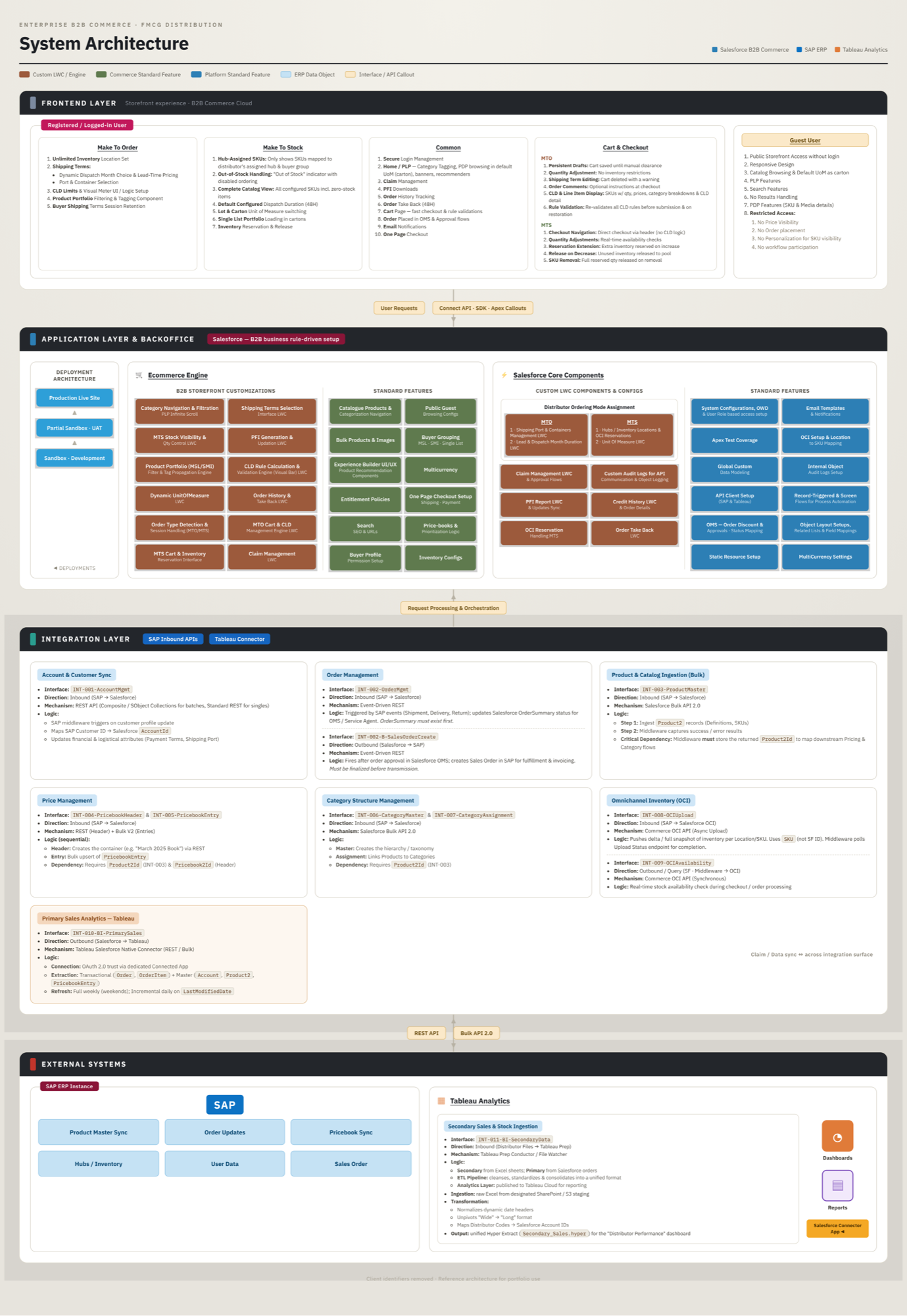
Architecture revealed as a system story.
Scroll through the technical decisions to see how each platform layer connects to the next.
 Open full-size diagram ↗
The full estate behind the portal: what a logged-in distributor sees, the ordering and approval logic behind it, the integration layer that keeps Salesforce and SAP in step, and the reporting that comes out the other side. Make-to-Order and Make-to-Stock are shown as separate paths because they behave differently all the way through.
Active decision
Used Apex and Lightning Web Components for account-aware storefront and operational experiences.
Architecture decision
Used Apex and Lightning Web Components for account-aware storefront and operational experiences.
Architecture decision
Used Salesforce Flow and Custom Metadata to make lifecycle communications and approval behaviour configurable.
Architecture decision
Separated Make-to-Order and Make-to-Stock rules while preserving one buyer experience.
Architecture decision
Kept client identifiers and operational data out of the public architecture representation.
07 / Engineering highlights
Where the hard problems were won
The proof points a technical buyer should inspect first.
Impact
Metadata-driven lifecycle communications
Order-lifecycle notifications configured through Salesforce Flow and Custom Metadata — a reusable pattern instead of one custom implementation per event.
Impact
Two supply models, one experience
Make-to-Order and Make-to-Stock rules separated behind the scenes — different availability, reservation and fulfilment behaviour under a single buyer experience.
Impact
SAP-linked operating model
Customer onboarding, order exchange, container planning, inventory reservation and pricing built on SAP-linked integration patterns.
Impact
Auditable by construction
Approvals, claims and post-checkout servicing flows remain auditable without hardcoded logic for every event.
08 / Technology
The delivery stack
Salesforce B2B Commerce
Apex
Lightning Web Components
Salesforce Flow
Custom Metadata
SAP Integration
Confidentiality protocol
Client, distributor, warehouse, region, endpoint, and production-data identifiers must remain anonymized. Use only approved screenshots or a sanitized redrawn architecture diagram.
Build with Marsos
Bring us the difficult system.We will make it buildable.
Start with a clear technical direction, an architecture that can scale, and a delivery plan your team can trust.