One Commerce Platform, Five Regional Markets
Running a separate storefront per region multiplies cost and slows every launch. Marsos worked across a single Salesforce Commerce Cloud estate serving Asia-Pacific, European and North American markets from one shared codebase — each market keeping its own catalogue, currency, payment methods, tax rules and loyalty programme.
Delivery signals
Shared foundation, localized markets
5 regions
Asia-Pacific, Europe and North America on one shared platform
12+
payment methods behind a single checkout
One codebase
new market launches without forking the platform
Custom loyalty
points earned, spent and audited in every market
01 / Context
The operating environment
A global jewellery retailer needed one commerce estate to support region-specific storefront composition across APAC, Europe, North America, and New Horizons or China while preserving shared investment in account, browse, checkout, jobs, integrations, and testing.
02 / Business outcome
What changed for the client
The result this engagement delivered — before any of the engineering behind it.
Enabled regional storefront composition without forking the shared commerce foundation for every market.
Supported cards, wallets, buy-now-pay-later, gift cards, private-label credit, loyalty tender, and market-specific payment conventions through one checkout estate.
Made loyalty redemption auditable and recoverable across cart, checkout, order, CRM, and failed-order scenarios.
Created a repeatable delivery model for multi-market releases and high-risk checkout regression coverage.
03 / Challenge
Complexity before transformation
Markets required different cartridge combinations, site data, locales, address rules, currencies, payments, tax, fraud, consent, and service configuration.
Regional payment options included cards, wallets, buy-now-pay-later, gift cards, private-label credit, loyalty points, and local payment conventions.
Loyalty points behaved as both engagement data and payment tender, requiring auditable basket, order, CRM, and recovery state.
The platform needed repeatable deployment and regression controls for high-risk checkout and loyalty paths.
04 / Delivery
What our technical team engineered
Composed market-specific cartridge and data stacks on top of shared SFRA, global, core, integration, job, and content layers.
Integrated regional payment methods through isolated payment cartridges and SFCC processors.
Built a custom loyalty layer covering tiers, points, benefits, split tender, zero-total checkout, CRM synchronization, and recovery jobs.
Established deployment, testing, linting, security-scanning, and load-test automation for controlled releases.
05 / How it works
The loyalty points lifecycle
The system, one step at a time — the sequence that carries an order, a shipment or a decision from start to done.
- 01
Earn simulation
Points earned are calculated and displayed pre-purchase — at login, cart, checkout and confirmation — before any commitment.
- 02
Apply and redeem
Maximum applicable points apply to the basket with recalculated totals — supporting split tender and orders fully paid with points.
- 03
Order placement
Redemption state, transaction IDs and earned points land on the order as durable audit metadata.
- 04
CRM synchronization
Tier level, consent state and loyalty profile data sync to the external customer golden record.
- 05
Recovery on failure
If order creation or payment fails after an external redemption call, unredeem jobs automatically return the points — with alerting on failed recoveries.
06 / System Architecture
Architecture revealed as a system story.
Scroll through the technical decisions to see how each platform layer connects to the next.
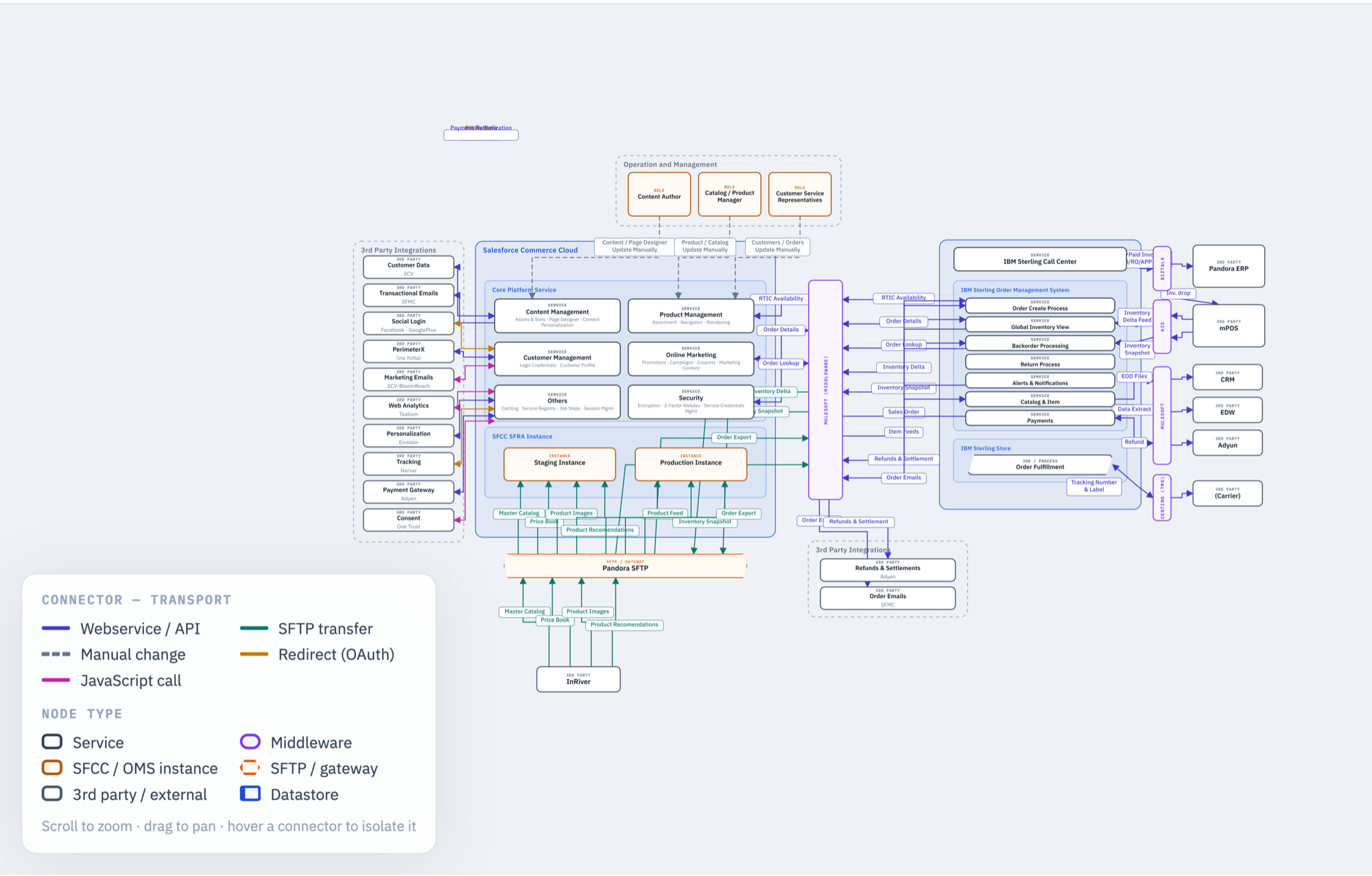 Open full-size diagram ↗
One commerce platform serving multiple regional markets, with the order management backbone on the right and third-party services on the left. Connector colour indicates transport — real-time API, scheduled file transfer, or redirect — which is the distinction that governs how quickly each market sees a change.
Active decision
Separated reusable global capabilities from region-specific data, preferences, services, content, and payment configuration.
Architecture decision
Separated reusable global capabilities from region-specific data, preferences, services, content, and payment configuration.
Architecture decision
Kept each payment integration behind a defined cartridge and processor boundary to limit cross-market impact.
Architecture decision
Stored durable loyalty audit state across basket, order, profile, site preferences, CRM, and operational recovery jobs.
Architecture decision
Used market-aware integrations for consent, tax, fraud, identity, CRM, Service Cloud, Marketing Cloud, and content services.
07 / Engineering highlights
Where the hard problems were won
The proof points a technical buyer should inspect first.
Impact
One estate, many markets
Market configs compose region-specific cartridge stacks and site data — APAC, EU and NAM — on top of shared SFRA, global and core layers, so regional rollout never forks the application.
Impact
Payment breadth without checkout sprawl
Cards, wallets, BNPL, gift cards, private-label credit, loyalty tender and local conventions (WeChat Pay, Konbini) — each isolated behind its own cartridge and payment processor.
Impact
Loyalty as currency and engagement
Custom basket/order metadata plus checkout middleware support split tender and fully-paid-with-points orders while keeping every redemption auditable.
Impact
Financial recovery built in
Unredeem jobs for created and failed orders, access-token refresh jobs and CRM fallbacks reduce accounting risk when external loyalty calls fail mid-order.
Impact
Localization at scale
Region-specific address forms and resource bundles across 10+ locales let shared features ship with localized legal, payment and account UI.
Impact
Compliance in the deployment model
Consent, tax, fraud and identity — OneTrust, TrustArc, Vertex, Signifyd, ID.me — embedded in the same delivery pipeline as commerce features.
08 / Platform surface
The capability map
Payment integrations
Market stacks
Platform services
09 / Technology
The delivery stack
Salesforce Commerce Cloud
SFRA
Multi-Market Architecture
Adyen
Afterpay
PayPal / Klarna
Custom Loyalty
CRM & Service Cloud
CI/CD Automation
Confidentiality protocol
Use public storefront imagery or sanitized diagrams only. Do not expose credentials, host secrets, private values, source-code paths, or raw client architecture documents.
Build with Marsos
Bring us the difficult system.We will make it buildable.
Start with a clear technical direction, an architecture that can scale, and a delivery plan your team can trust.