Autoship & Recurring Orders
Repeat customers were reordering the same food by hand every few weeks, and every point of friction cost a subscription. Marsos built the recurring-order engine and the self-service portal around it — customers set their own delivery rhythm, swap products, pause or skip without calling anyone, and one failed payment no longer holds up everybody else's deliveries.
Delivery signals
The actual integration map
Self-service
cadence, address, payment and products changed without contacting support
Pause, don't cancel
customers can skip a delivery instead of leaving
Isolated failures
one declined card cannot stop the rest of the batch
Told in advance
customers notified before each delivery is charged
01 / Context
The operating environment
Vet-prescribed and everyday pet food is naturally repeat-purchase commerce. JustFoodForDogs needed a durable recurring-order model that customers could manage themselves without making a third-party subscription platform the system of record.
02 / Business outcome
What changed for the client
The result this engagement delivered — before any of the engineering behind it.
Turned repeat pet-food purchasing into a self-managed recurring-delivery relationship.
Allowed customers to manage cadence, address, payment, products, pause, resume, and cancellation without relying on support.
Isolated subscription failures so one declined or invalid order could not stop the scheduled batch.
Kept subscription ownership in SFCC while using a decoupled Vue.js portal as an API-driven customer experience.
03 / Challenge
Complexity before transformation
The storefront supported one-off checkout while customers had to remember to reorder recurring pet-food products.
Customers needed to change cadence, shipping address, payment method, products, or subscription status without support intervention.
Recurring orders needed scheduled creation, current product and price validation, first-order promotion handling, and isolated failure behaviour.
Operations needed visibility into subscribers, upcoming shipments, missing-payment customers, and automated status or failure communication.
04 / Delivery
What our technical team engineered
Built native subscription and recurring-order logic inside Salesforce Commerce Cloud.
Built subscription creation from checkout and customer accounts with configurable cadence, address, payment, and line-item data.
Built scheduled order creation with product validation, live-item resolution, repricing, first-order promotion logic, and per-subscription failure isolation.
Built a separate Vue.js self-service portal that uses SFCC APIs for viewing, rescheduling, swapping products, pausing, resuming, and cancelling subscriptions.
05 / System Architecture
Architecture revealed as a system story.
Scroll through the technical decisions to see how each platform layer connects to the next.
 Open full-size diagram ↗
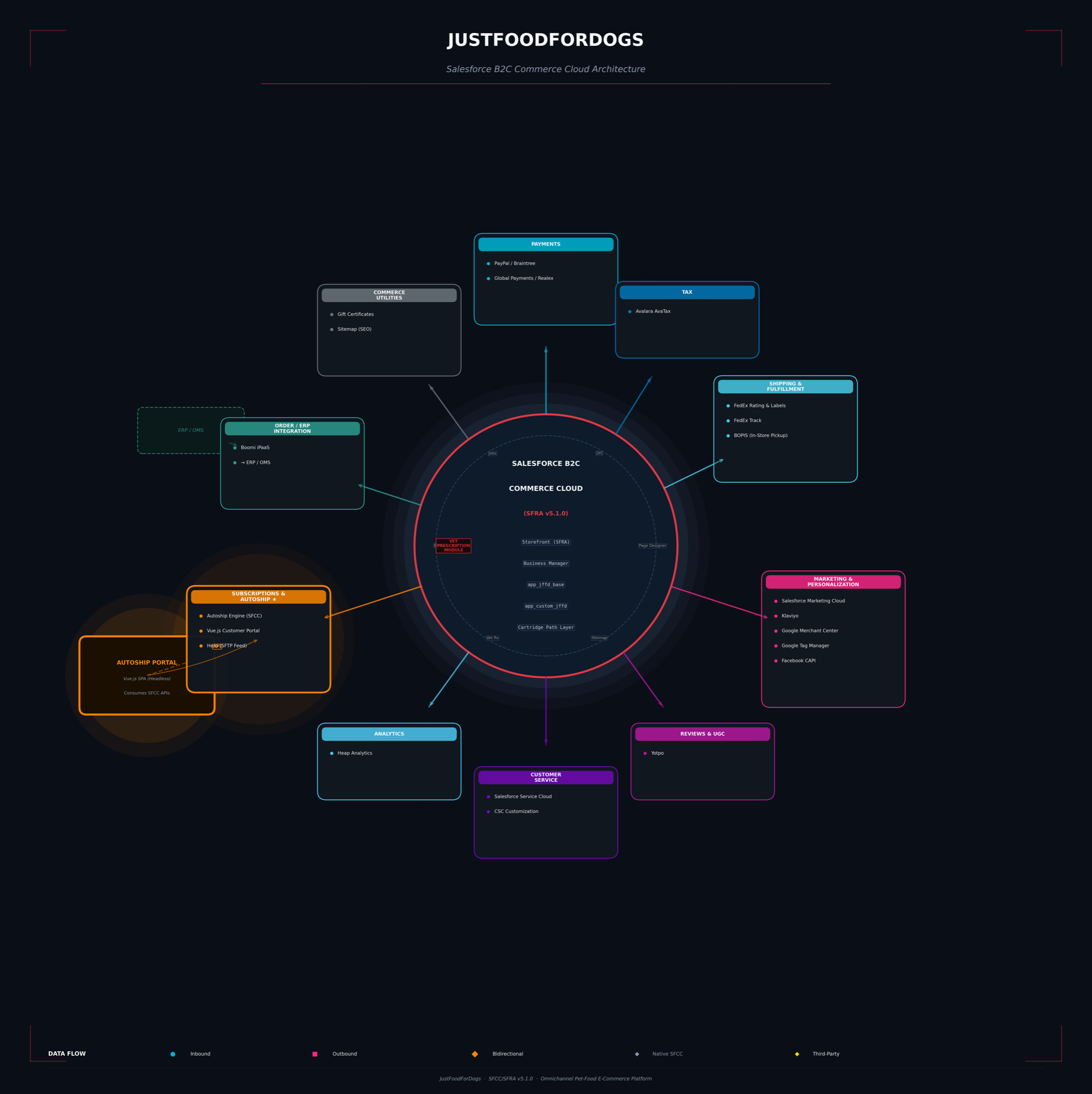
The commerce core at the centre with each integration cluster around it — payments, tax, shipping, subscriptions, marketing, service and reviews. The autoship engine and its standalone customer portal are highlighted because that subscription path is what the engagement was built around.
Active decision
Stored subscription state as JSON on the customer profile, avoiding a separate subscription database and migration overhead.
Architecture decision
Stored subscription state as JSON on the customer profile, avoiding a separate subscription database and migration overhead.
Architecture decision
Used the SFCC Jobs Framework with configurable lead-time windows for daily recurring-order processing.
Architecture decision
Placed orders through registered service calls per subscription so one failure would not stop the whole batch.
Architecture decision
Paused declined-payment subscriptions and excluded them from later runs until resolved, preventing repeated failed charge attempts.
06 / Engineering highlights
Where the hard problems were won
The proof points a technical buyer should inspect first.
Impact
Autoship as the business differentiator
A recurring-order engine inside SFCC paired with a standalone Vue.js customer portal — a headless client consuming SFCC APIs, architecturally outside the cartridge stack.
Impact
Prescription-gated commerce
A bespoke Business Manager module gates vet-prescribed diet products — custom platform capability, not a third-party bolt-on.
Impact
Hub-and-spoke integration model
Payments, tax, shipping, marketing, reviews, service, analytics and subscriptions radiate from the SFRA core as color-coded functional clusters.
Impact
ERP sync through iPaaS
Boomi middleware syncs orders out of SFCC to downstream ERP/OMS systems — decoupling commerce from fulfilment infrastructure.
07 / Platform surface
The capability map
Integration clusters
08 / Technology
The delivery stack
Salesforce B2C Commerce
SFRA
Vue.js
SFCC Jobs Framework
SFCC APIs
Business Manager
Recurring Payments
Automated Email
Confidentiality protocol
Use approved public storefront imagery or a redrawn architecture diagram. Do not publish internal cartridge names, source-code paths, private API details, customer data, or raw source documents.
Build with Marsos
Bring us the difficult system.We will make it buildable.
Start with a clear technical direction, an architecture that can scale, and a delivery plan your team can trust.