Migration Playbook
Composable commerce promises an API-first, independently replaceable stack — but replatforming a live store is where most programmes lose money. This is the method Marsos uses to migrate to a headless, MACH-style architecture without a big-bang cutover: match the existing experience before changing it, decouple one layer at a time, and keep every phase reversible until the replacement has earned production trust.
Delivery signals
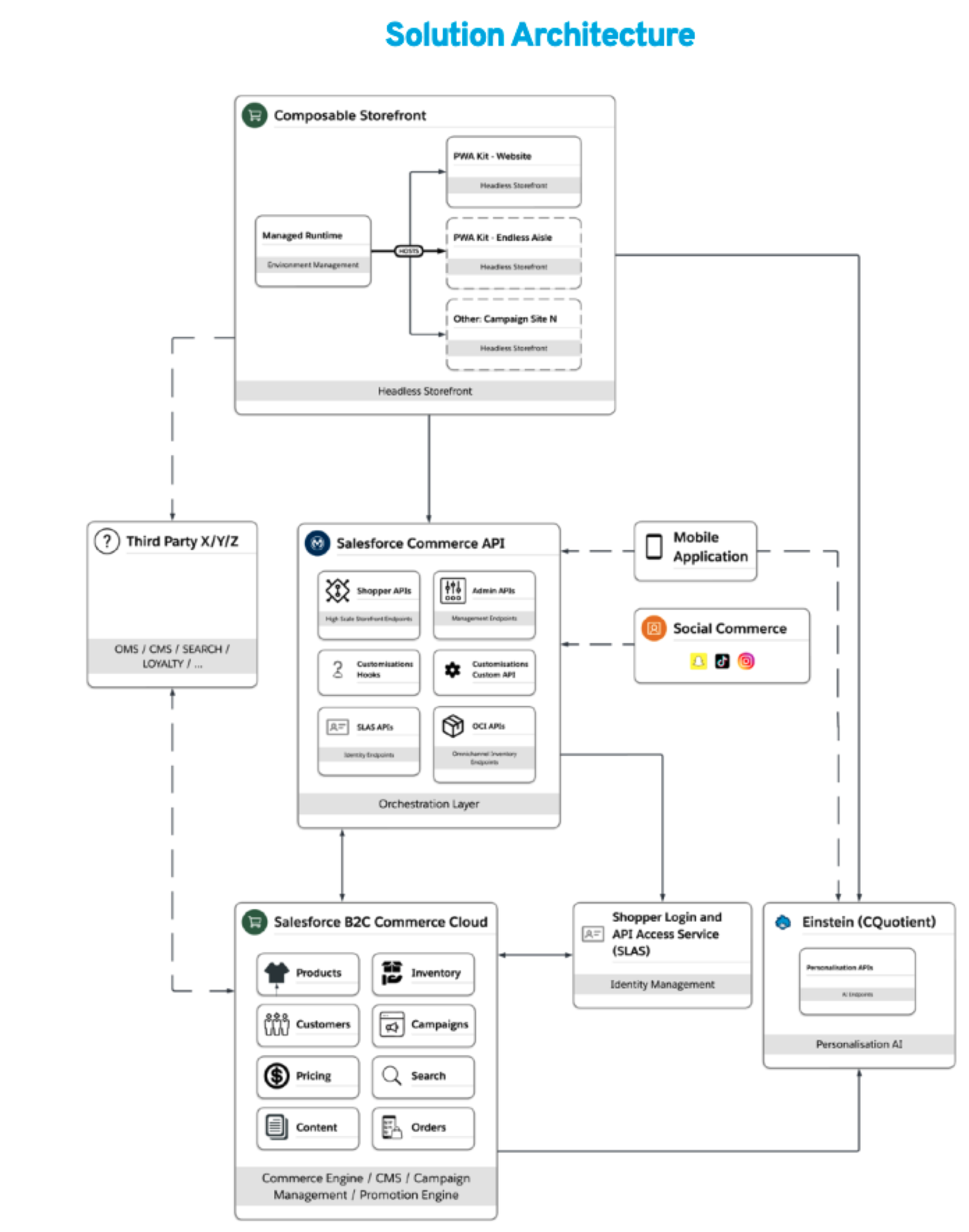
Composable storefront reference architecture
Parity first
match the current store before changing anything customers see
Reversible
every phase can be rolled back on its own
No big-bang
the existing platform keeps trading until the new path is proven
Swappable
commerce, content, search and payments replaced independently
01 / Context
The operating environment
This is a Marsos capability study, not a single-client engagement. It explains the methodology, reference architecture, delivery controls, and anonymized proof points used when decoupling storefront or content experiences from incumbent engines.
02 / Business outcome
What changed for the client
The result this engagement delivered — before any of the engineering behind it.
Creates a low-risk migration path in which each phase can be validated and reversed independently.
Preserves proven flows on the incumbent platform until the replacement path has earned production trust.
Makes commerce, content, search, payments, loyalty, reviews, analytics, and identity independently composable and replaceable.
Applies the same parity-first and phased-risk discipline across commerce and content decoupling programmes.
03 / Challenge
Complexity before transformation
Monolithic experience and engine layers force frontend and backend releases to move together.
Redesigns and channel changes become platform changes, while new search, CMS, payment, loyalty, or analytics providers are difficult to adopt independently.
Big-bang replacement puts proven revenue flows at unnecessary risk.
Unbounded upstream calls, visual drift, migration ambiguity, and incomplete quality checks can destabilize a headless transition.
04 / Delivery
What our technical team engineered
Defined an engine-agnostic reference model spanning experience, API orchestration, commerce, CMS, search, payment, loyalty, identity, and analytics layers.
Defined a phased delivery method: assess, decouple, reach parity, stabilize hybrid operation, and complete cutover.
Documented an edge-rendered product-page pattern with source-of-record product detail, composable discovery, targeted content, caching, and strict upstream timeouts.
Defined release controls covering performance, accessibility, internationalization, SEO, security, testing, migration status, and rollback.
05 / How it works
The migration path
The system, one step at a time — the sequence that carries an order, a shipment or a decision from start to done.
- 01
Assess
Audit the monolith. Map domains, integrations and the system of record for each capability.
- 02
Decouple
Stand up a headless frontend and peel off capabilities behind APIs, one domain at a time.
- 03
Parity first
Match production on the first pass — no drift, no "we'll fix it later."
- 04
Stabilize hybrid
Run new and legacy side by side; keep proven flows on the incumbent until the new path earns trust.
- 05
Full cutover
Shift the last flows over once metrics and stability hold steady.
06 / System Architecture
Architecture revealed as a system story.
Scroll through the technical decisions to see how each platform layer connects to the next.
01 · Composable storefront — reference model
 Open full-size diagram ↗
The target shape: multiple front ends sharing one orchestration layer, with commerce, identity, personalisation and third-party services independently replaceable. Third parties appear by role rather than by vendor because the pattern holds whichever product fills each slot.
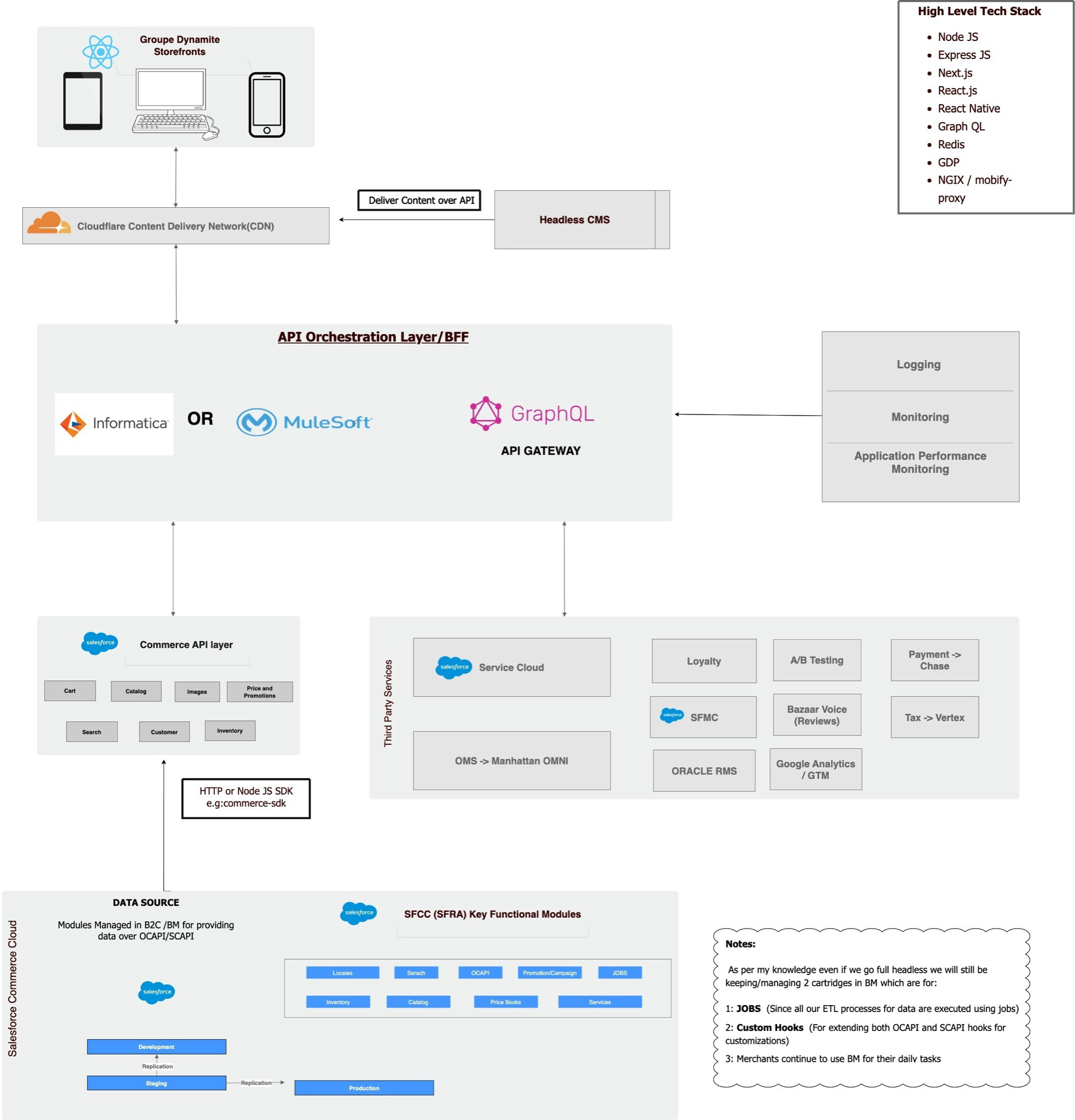
02 · The same model in production
 Open full-size diagram ↗
A real retail implementation of that reference model — the API orchestration layer, the CDN in front of it, and the actual service choices made for order management, tax, reviews, loyalty and analytics. Useful alongside the reference model to see which decisions are structural and which are swappable.
Active decision
Assess the monolith and map domains, integrations, ownership, and systems of record before implementation.
Architecture decision
Assess the monolith and map domains, integrations, ownership, and systems of record before implementation.
Architecture decision
Decouple one capability at a time behind documented APIs while keeping each phase independently revertible.
Architecture decision
Match production behaviour and visual parity before expanding the new path.
Architecture decision
Run new and legacy flows side by side until stability and operational metrics support full cutover.
07 / Engineering highlights
Where the hard problems were won
The proof points a technical buyer should inspect first.
Impact
Production headless rearchitecture
A Cloudflare Workers React SSR storefront replacing a legacy PWA / Managed-Runtime stack for a multi-site health and wellness retailer.
Impact
API-layer depth
OCAPI, SCAPI and SLAS exercised in production — including a hybrid session bridge between legacy and headless surfaces.
Impact
Headless CMS and commerce pairing
Hands-on Magnolia + SFCC + PWA Kit reference architecture — marketer-editable page models with MACH-style decoupling.
Impact
De-risked by construction
Phased, independently revertible rollout; proven flows stay on the incumbent until the new path earns trust; timeouts cap every upstream call.
08 / Platform surface
The capability map
Layers we decouple
09 / Technology
The delivery stack
React
PWA Kit
React Router SSR
Cloudflare Workers
SFCC SCAPI
OCAPI
SLAS
Headless CMS
Composable Search
API Orchestration
Confidentiality protocol
Present this record clearly as a Marsos capability study. Anonymized proof points may support the methodology, but the page must not imply that the complete reference architecture belongs to one client delivery.
Build with Marsos
Bring us the difficult system.We will make it buildable.
Start with a clear technical direction, an architecture that can scale, and a delivery plan your team can trust.